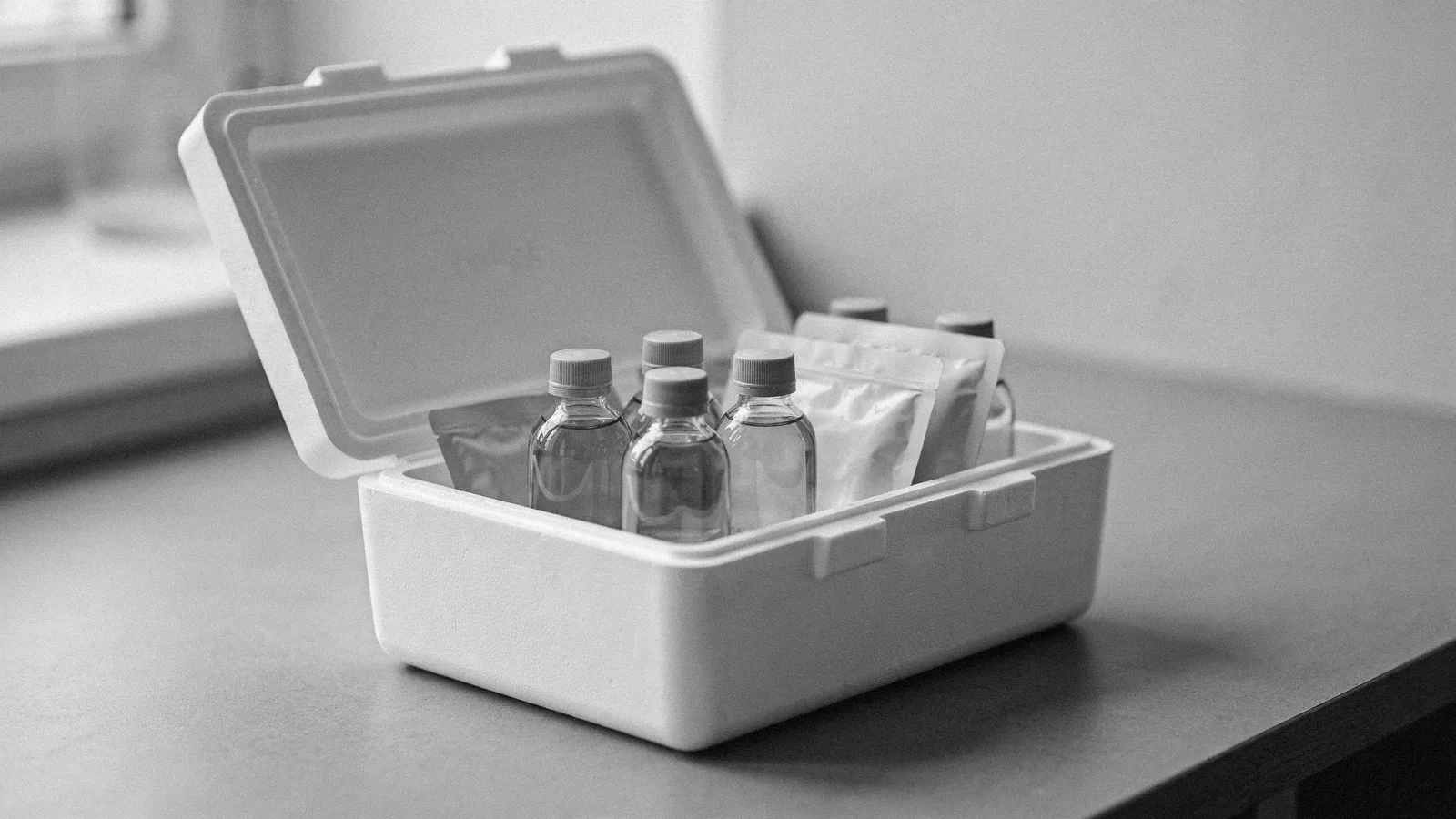
A research shipment that needs to stay cold is only as good as the evidence that it did. When a box arrives at a laboratory, the receiving technician has a few minutes to answer a practical question: did the contents stay inside their stated temperature range from the moment the shipper sealed the box until now, and can the lab show how it knows?
Answering that question well depends on decisions made before the box ever left the dock: the packaging system, the refrigerant, the indicator or logger inside, and the transit time the package was built to survive. This article walks through each of those, then sets out what a receiving lab should write down on arrival so that the record holds up later.
Match the packaging system to the storage condition
Start from the storage condition printed on the lot documentation, not from what is convenient to ship. Most research reagents fall into one of four bands, and each calls for a different packaging approach.
- Controlled room temperature. An insulated liner may still be worth using in summer or winter, because a delivery vehicle can run far hotter or colder than a building.
- Refrigerated (commonly 2 to 8 °C). An insulated shipper with conditioned refrigerant packs. The packs must be conditioned to the temperature the packaging maker specifies. Packs taken straight from a freezer can push contents below 0 °C, which matters for liquids and for materials that should not freeze.
- Frozen. Frozen gel packs for moderate freezer ranges, or dry ice (solid carbon dioxide, which sublimes at about −78.5 °C) for deep-frozen material.
- Cryogenic. A dry shipper, in which liquid nitrogen is absorbed into a porous material so there is no free liquid in transit.
USP general chapter <659>, Packaging and Storage Requirements, defines storage terms such as refrigerator and freezer as specific temperature ranges. Using those defined terms on labels and documents avoids the ambiguity of phrases like "keep cool."
Insulated shippers, usually expanded polystyrene or polyurethane inside a corrugated outer box, are sold as systems with a rated duration under a stated ambient profile. That rating only holds when the shipper is packed the way it was qualified: the same number and placement of refrigerant packs, the same payload volume, and the same void fill. A half-empty shipper with extra air space, or refrigerant packs moved to one side, is a different system from the one that was tested.

Dry ice and data loggers are regulated goods
Dry ice is a hazardous material for transport. In the United States, 49 CFR 173.217 sets the conditions for shipping carbon dioxide, solid, and for air transport the IATA Dangerous Goods Regulations apply. The practical points are consistent across both.
- The package must let carbon dioxide gas escape. A sealed, airtight container can build pressure and rupture.
- The outer package is marked with UN1845, the proper shipping name ("Dry ice" or "Carbon dioxide, solid"), and the net quantity of dry ice in kilograms, and for air shipments it carries the Class 9 hazard label.
- Staff who prepare dry ice shipments by air need dangerous goods training appropriate to their role.
Electronic temperature loggers usually contain lithium cells, and lithium batteries have their own transport provisions. Loggers sold for shipping are generally designed to meet them, but the shipper should confirm this with the logger maker rather than assume it.
Temperature indicators and loggers: what each one can prove
A cold-chain package can carry three kinds of evidence, and they answer different questions.
| Device | What it shows | What it cannot show |
|---|---|---|
| Irreversible threshold indicator | That the package exceeded (or fell below) a set temperature, sometimes for a minimum time | How long, how far, or when the excursion happened |
| Freeze indicator | That the contents area reached freezing conditions | Anything about high-temperature exposure |
| Electronic data logger | A time-stamped temperature trace for the whole trip | Conditions outside its sensor location, or anything if it was never started |
Indicators are inexpensive and easy to read at the door, which makes them useful as a first screen. A logger gives the lab a record it can file with the lot. Loggers used for decisions should have a calibration certificate, ideally from a laboratory accredited to ISO/IEC 17025, and the sensor or probe should sit near the contents, not against a refrigerant pack.
Two habits make either device trustworthy. The shipper activates the indicator or starts the logger at pack-out and records the time, and the shipment paperwork states which device is inside and what its alarm limits are. A logger that was never started, or an indicator with no stated threshold, produces nothing a receiving lab can use.
Plan transit time before choosing a service
Transit time is the variable most often left to chance. The goal is simple: the planned door-to-door time, plus a margin for delay, should sit comfortably inside the rated duration of the packaging system.
- Ship early in the week, so that a one-day delay does not leave a package in a depot over a weekend.
- Check the carrier calendar and the recipient's holiday schedule before shipping.
- Confirm with the receiving lab that someone will be present to accept the package and move it to storage the same day.
- Choose a service level whose guaranteed delivery time leaves headroom, and add extra refrigerant or dry ice only within what the packaging instructions allow.
- Send tracking details and the expected arrival window to the receiving contact on the day of shipment.
Seasonal conditions change the math. A shipper qualified against a summer profile may still need a different pack-out in deep winter, when refrigerated contents can freeze in an unheated vehicle.
What the receiving lab should record on arrival
The arrival record is the lab's half of the chain of custody. It should be written at the time of receipt, by the person who opened the box, on a form or in a system that ties it to the lot. A useful record captures the following.
- Date and time of receipt, the carrier, the tracking number, and the name of the person receiving.
- Outer package condition: crushed corners, punctures, water damage, or a broken seal. Photograph anything unusual before opening.
- Refrigerant status: dry ice still present (and roughly how much), gel packs frozen, partly thawed or fully liquid.
- Indicator status, exactly as read, including the indicator type and threshold.
- Logger data: stop the logger, download or read the trace, note the minimum and maximum values and any alarm, and attach the file to the receiving record.
- Contents check: container count, closure integrity, and the lot numbers on each container compared against the packing list and the certificate of analysis.
- Time placed into storage and the storage location, such as the freezer and rack position.
Frozen or refrigerated containers of lyophilized material should be allowed to reach room temperature in a closed state before the container is opened, so that moisture does not condense on the solid. Record that as part of handling rather than as part of receipt.
When something is outside range
If the indicator has tripped, the logger shows an excursion, or the refrigerant is spent, do not quietly move the material into general stock. Place it in labeled quarantine storage at its stated condition, keep the packaging and the device, and contact the supplier with the record and photographs. The supplier can then compare the excursion against any stability data for the material and give a written disposition. The lab keeps that decision with the lot record.
Checklist for shippers and receiving labs
- Choose packaging by the storage condition on the lot documentation, using defined storage terms.
- Pack the shipper exactly as it was qualified, with conditioned refrigerant.
- Mark, label and vent dry ice shipments according to 49 CFR 173.217 and, for air, the IATA Dangerous Goods Regulations.
- Start the indicator or logger at pack-out, and state the device and its limits in the paperwork.
- Keep planned transit time plus margin inside the rated duration, and avoid weekend holds.
- On arrival, record receipt details, package and refrigerant condition, indicator or logger data, lot numbers and time into storage.
- Quarantine anything with an excursion and get a written disposition from the supplier.
For related reading on lot paperwork, see the other articles on the ruogate blog.